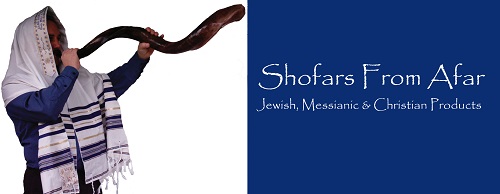
The Tallit Prayer Shawl
The Tallit (Prayer Shawl)
and The TzitTzit (Fringes)
copyright 2005 Dr.Rick Kurnow
“The Tallit” is pronounced “Tah leet”, plural is tallitot (tallits). It is also called a “talis” (plural is taleisim) in modern Hebrew. TALITH contains two Hebrew words: TAL meaning tent and ITH meaning little. Literally a LITTLE TENT.
The Biblical reason for the Tallit is found in:
Numbers 15:37-41 Again the LORD spoke to Moses, saying,38 “Speak to the children of Israel: Tell them to make tassels on the corners of their garments throughout their generations, and to put a blue thread in the tassels of the corners.39 And you shall have the tassel, that you may look upon it and remember all the commandments of the LORD and do them, and that you may not follow the harlotry to which your own heart and your own eyes are inclined,40 and that you may remember and do all My commandments, and be holy for your God.41 I am the LORD your God, who brought you out of the land of Egypt, to be your God: I am the LORD your God.”
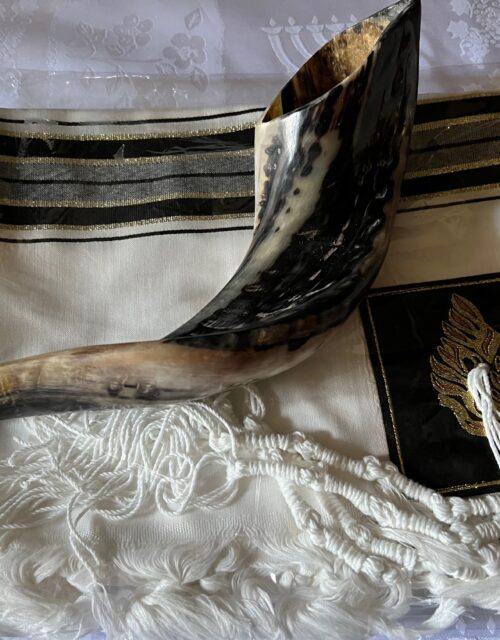
The most important part of the tallit is the tzitzit on its corners. The design of the tallit itself only has a few requirements. The tallit must be long enough to be worn over the shoulders (as a shawl), not just around the neck (as a scarf), to fulfill the requirement that the tzitzis be on a “garment.” You will find today many beautiful designs that will reflect a specific biblical message. It may be made of any material, but must not be made of a combination of wool and linen, because that combination is forbidden on any clothing according to:
Deuteronomy 22:11 11 “You shall not wear a garment of different sorts, such as wool and linen mixed together. 12 “You shall make tassels on the four corners of the clothing with which you cover yourself.
The various parts of the Tallit
Tzitzit: tassel, fringe also translated as border or fringe in. The plural is tzitziot. These are the long twisted cords (gedillum) on the four corners (kanfot also translated as wing). In Hebrew each letter has a numerical value. Therefore each word has a numerical value. For example, on each tzitzit (tassel) there were 39 windings (7+8+11+13 separated by double knots) It is interesting to note that Jesus suffered the same number of stripes for our healing. 26 is the numerical value of YHWH. 13 is the numerical value of
Page 2
Echad (one). Therefore these windings on each tzitzit equals the numerical value of the Hebrew words “YAWEH Echad” The Lord is One .
This is from the “Shema”. Found in:
Deuteronomy 6:4
Hear, O Israel: The LORD our God, the LORD is one!
.
Each tzitzit have seven white strands, the number of perfection, surrounded by the blue “servant” depicting royalty. It now adds up to eight, the number of new beginnings
In addition, if you add 600 which is the value of tzitzit and the 5 knots and 8 strands, they equal 613 that are the number of mitzvahs (commandments or instructions) in the Tanakh (Old Testament) given through Moses.
Techelet: the blue strand in the tzitzit that is dyed with a special blue dye from the gland of the “chillizon” (murex snail). The blue is like royal blue or turquoise. Many Tallit today do not have the Techelet because the snail that the color comes from is extinct. At the death of Yeshua, we are told that the snail disappeared and was thought to be extinct. About ten years ago the chillazon snail reappeared and the process to obtain the blue dye has been re-established. It is interesting to note that the snail disappeared at the death of Yeshua and has reappeared today with the rest of the signs of His imminent return.
Atarah: is the neckpiece or “crown”. It is considered the top of the tallit. It can be of any design. The most common have the blessing for putting on the Tallit in Hebrew
Corners: Are reinforced with corner pieces to keep the tzitziot from tearing off. They are generally on the “inside”
Colors: Most Orthodox Jews wear black for mourning the destruction of the Temple and to not draw attention to themselves. The most traditional color is the blue with either no trim or with gold or silver. The blue is associated with righteousness and gold the Glory of God’s manifest presence.
Materials: Wool is the preferred material. It lasts longer and hangs better. Other materials are rayon which is silk like. Raw silk which is beautiful but expensive.
Blends like wool and polyester. Other synthetics are made from acrylic called “Acrylon” and is very light and inexpensive.
The Traditional Prayer on the Atarah
The words on the tallit (prayer shawl) are usually the blessing that is said before wrapping oneself up in the shawl. The words are: “Baruch Attah Adonai Eloheinu Melech Ha’olam asher kidshanu bemitzvotav vetzivanu lehit’atef betzitzit”. In translation: Blessed are you, O Lord our God, King of the universe, who has sanctified us by your commandments, and commanded us to cover ourselves in fringes.
Page 3
When devout Jews cover themselves, they believe that they are covering themselves in the righteousness of the law. They are committing their hearts to follow after all the law.
But how many people no matter how devout they are can follow all 613 laws. How many people do you know that have kept the 10 commandments? The New Testament tells us:
Galatians 3:19-25
What purpose then does the law serve? It was added because of transgressions, till the Seed should come to whom the promise was made; and it was appointed through angels by the hand of a mediator.20 Now a mediator does not mediate for one only, but God is one. 21 Is the law then against the promises of God? Certainly not! For if there had been a law given which could have given life, truly righteousness would have been by the law.22 But the Scripture has confined all under sin, that the promise by faith in Jesus Christ might be given to those who believe.23 But before faith came, we were kept under guard by the law, kept for the faith which would afterward be revealed.24 Therefore the law was our tutor to bring us to Christ, that we might be justified by faith.25 But after faith has come, we are no longer under a tutor.
The law is a mirror. It is a measuring stick that proves to all that they have sin in their life. If there is no standard than we would never know we have not kept that standard. The good news is that Yeshua fulfilled all the law. If we had the ability to keep all the law then Yeshua did not have to come and take the punishment of our sin on himself.
Galatians 2:21
21 I do not set aside the grace of God; for if righteousness comes through the law, then Christ died in vain.”
James 2:10
10 For whoever shall keep the whole law, and yet stumble in one point, he is guilty of all.
2 Corinthians 5:21
21 For He made Him who knew no sin to be sin for us, that we might become the righteousness of God in Him.
When a believer in Yeshua (Jesus) puts on a Tallit they are reminded that Jesus fulfilled all the law and now they are covered in His righteousness.